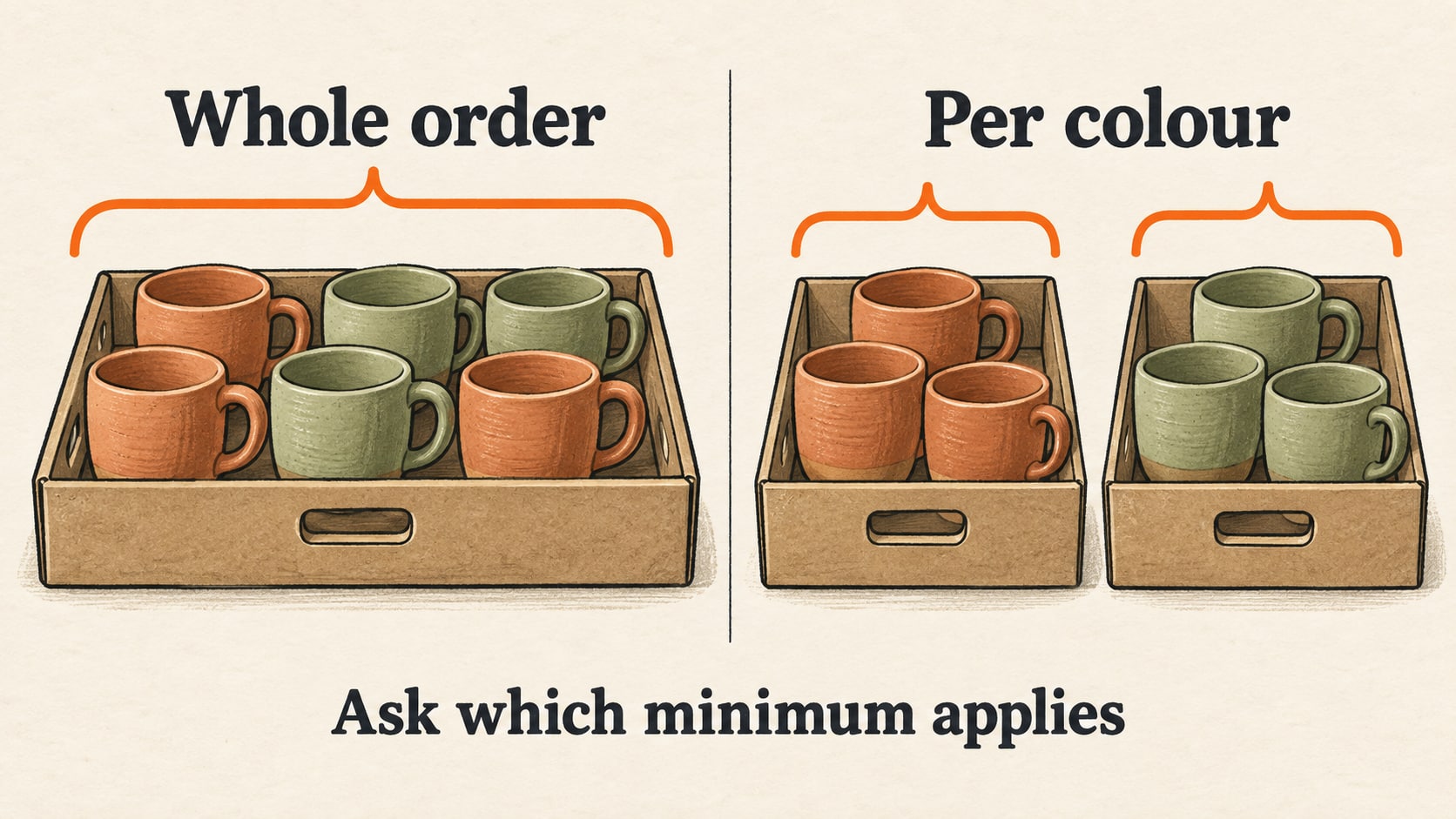
MOQ means minimum order quantity: the smallest quantity a supplier will accept for an order. It can apply to the whole order, a particular product or each colour and size. That last detail matters when you're deciding how much stock to buy. Shopify explains the different order constraints.
Start with the range you actually want to sell. Until the supplier confirms which items can count together, you don't know whether their minimum fits your plan.
Find out what the minimum applies to
“Can I mix colours?” is a useful question. “Can I mix these colours, in these sizes, with this personalisation?” gives the supplier something they can confirm.
Send your intended variant split with the product reference. Get the reply attached to that same version of the order.
| If the minimum applies to… | What you need to establish |
|---|---|
| The whole order | Which products can count towards it together? |
| Each product | Can its colours and sizes be combined? |
| Each variant | Does every colour or size need its own minimum? |
| A personalised version | Can individual names or designs differ within the order? |
The distinction changes how much of each item you'll hold. A total you can comfortably buy may become awkward when it has to be split across variants you haven't sold yet.
Keep those quantities visible when comparing suppliers. The lower unit price isn't much help if reaching it means buying a range your shop doesn't need.
Separate the order rules from the money due
Quantity is only part of the decision. A quote can also have a minimum spend or require you to buy in pack multiples. A minimum spend sets the amount you must buy; a pack-size rule means ordering in complete packs. Write each rule on its own line so you can check the actual order against all of them.
Then separate the money into two views:
- The full order cost: products, packing, delivery and any other confirmed charges.
- What's due now: the payment required to start the order, including any stock or packaging purchase that sits outside the product quote.
A deposit that's part of the product total belongs in the payment schedule. Adding it to the total again would count the same money twice.
Keep unconfirmed charges beside the total. An unanswered shipping question doesn't become a free service because you've already got a product price.
Personalisation and individual dispatch need separate answers
For personalised products, there are two jobs to agree: making the items and getting each one to the right customer.
A supplier's ability to combine personalised items into a production batch doesn't tell you whether they'll dispatch separate parcels. And a service that sends individual parcels may still require you to purchase stock first.
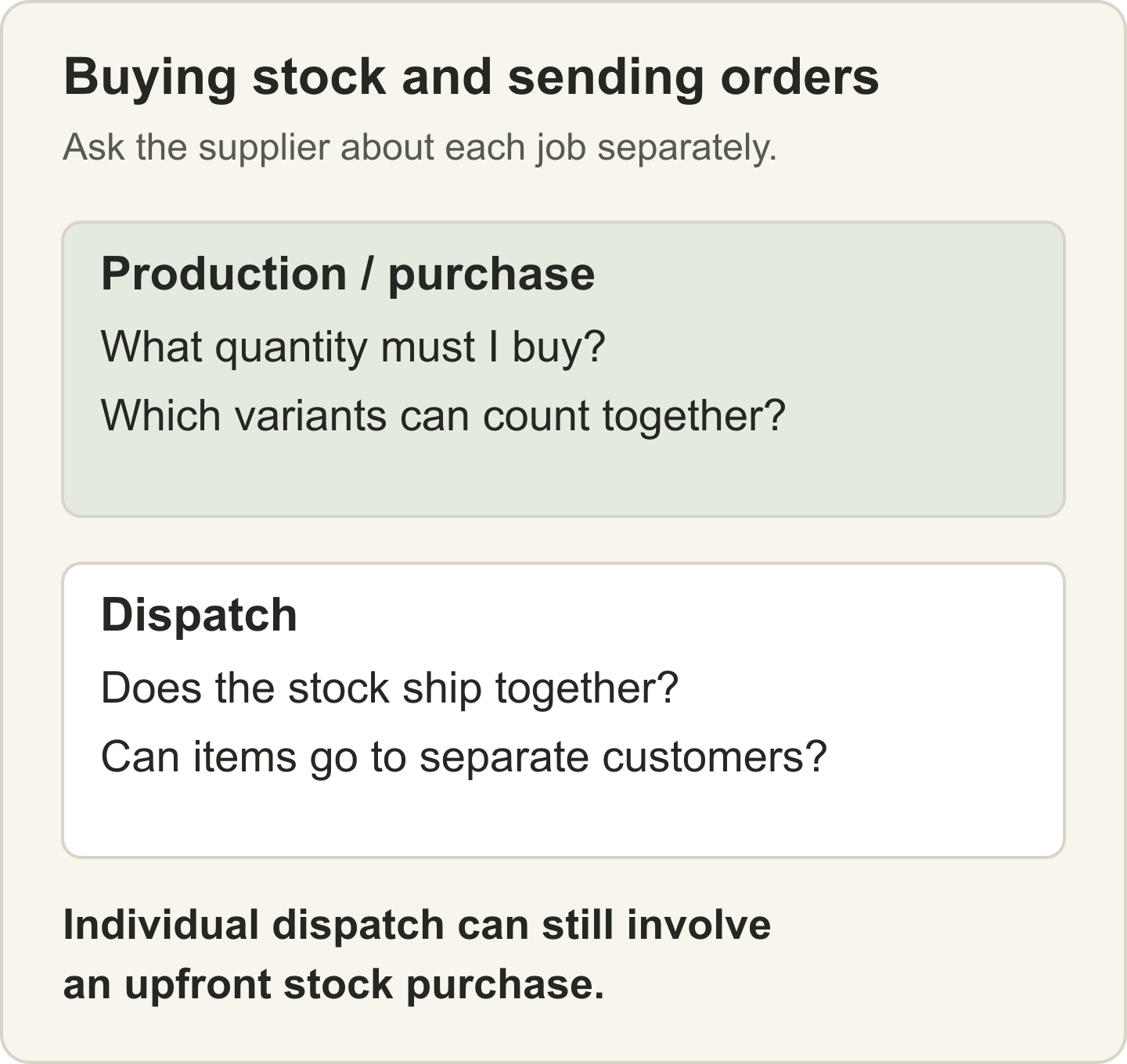
Get clear on the point at which you pay for the product. Is it made after a customer orders, taken from stock you've already bought, or produced in a batch once enough orders are ready?
If stock is held for you, agree who owns it, how it is counted and what happens to unused items or packaging when you stop ordering.
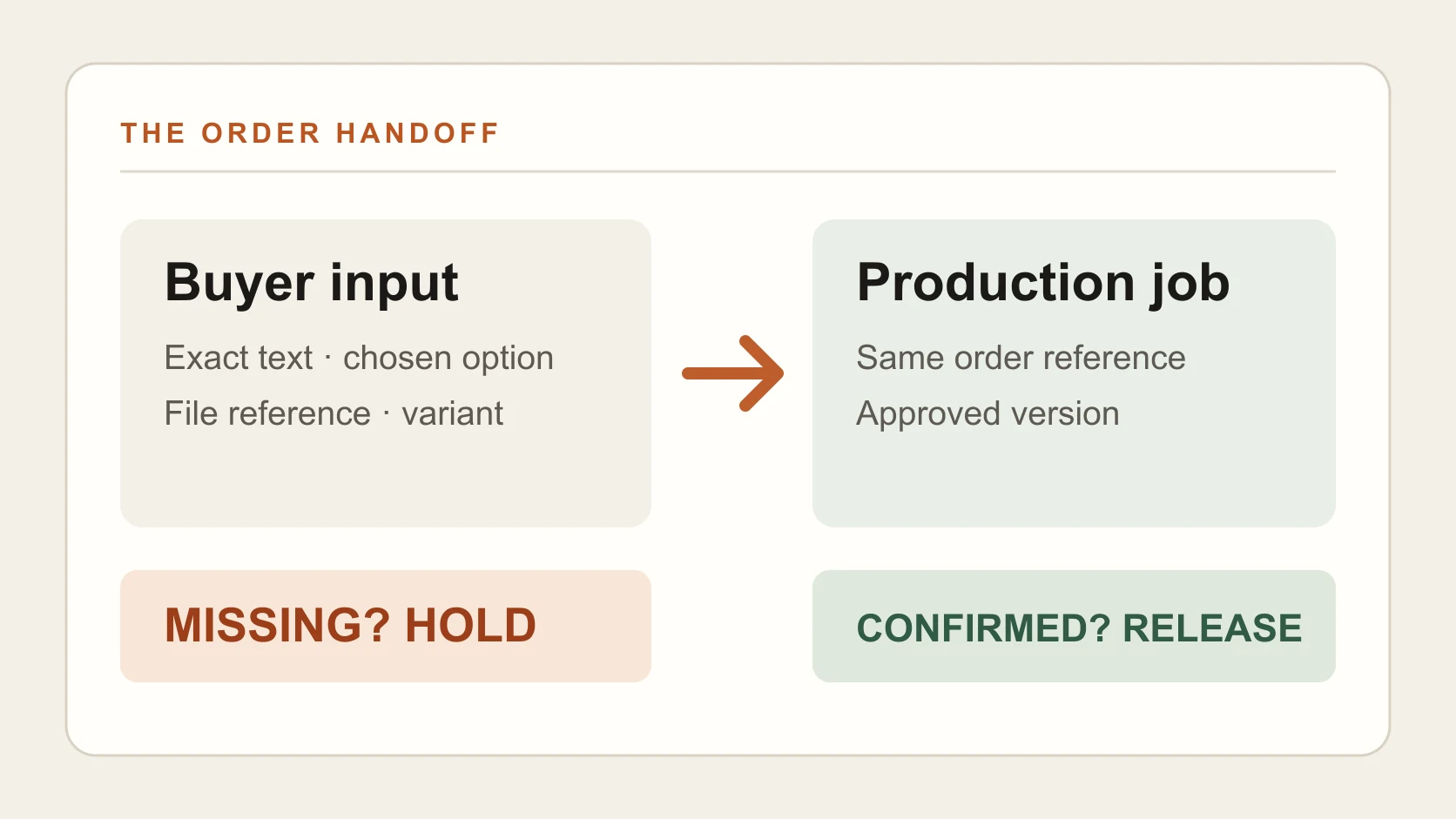
Then settle how the personalisation travels with it: the order reference, exact text or image, approval and delivery details. The packer needs to be able to match a finished item to its customer without guessing from a message thread.
For an Etsy shop, check production-partner eligibility and disclosure before building the listing around that arrangement.
How to ask for a smaller order
Find out what sets the minimum before proposing a change. Material purchasing, production setup and packaging can each need a different discussion; you can't assume removing a printed box will solve it.
Ask the supplier to price your intended quantity alongside the quantity they originally offered. Keep the product specification and destination fixed so you can see what the smaller order changes.
If branding is optional for the first run, request plain packaging as a separate alternative. If a material change is proposed, keep it separate too. You'll need to decide whether the revised product still does the job, and whether another sample is needed.
Compare the amount committed as well as the price per item. Paying more per unit can be a sensible choice when it leaves you with a manageable first order. It still needs to work at your selling price.
Use the quantity you're prepared to buy. A forecast for later orders is useful context, but it shouldn't quietly become a commitment you've made to get today's price.
Send a request the supplier can answer
Attach the product reference and your actual colour or size split. Replace the brackets before sending.
Read the reply against your proposed order. If a minimum or charge is still unclear, send that specific point back before accepting. The quote comparison worksheet gives you somewhere to keep those open questions alongside the prices.