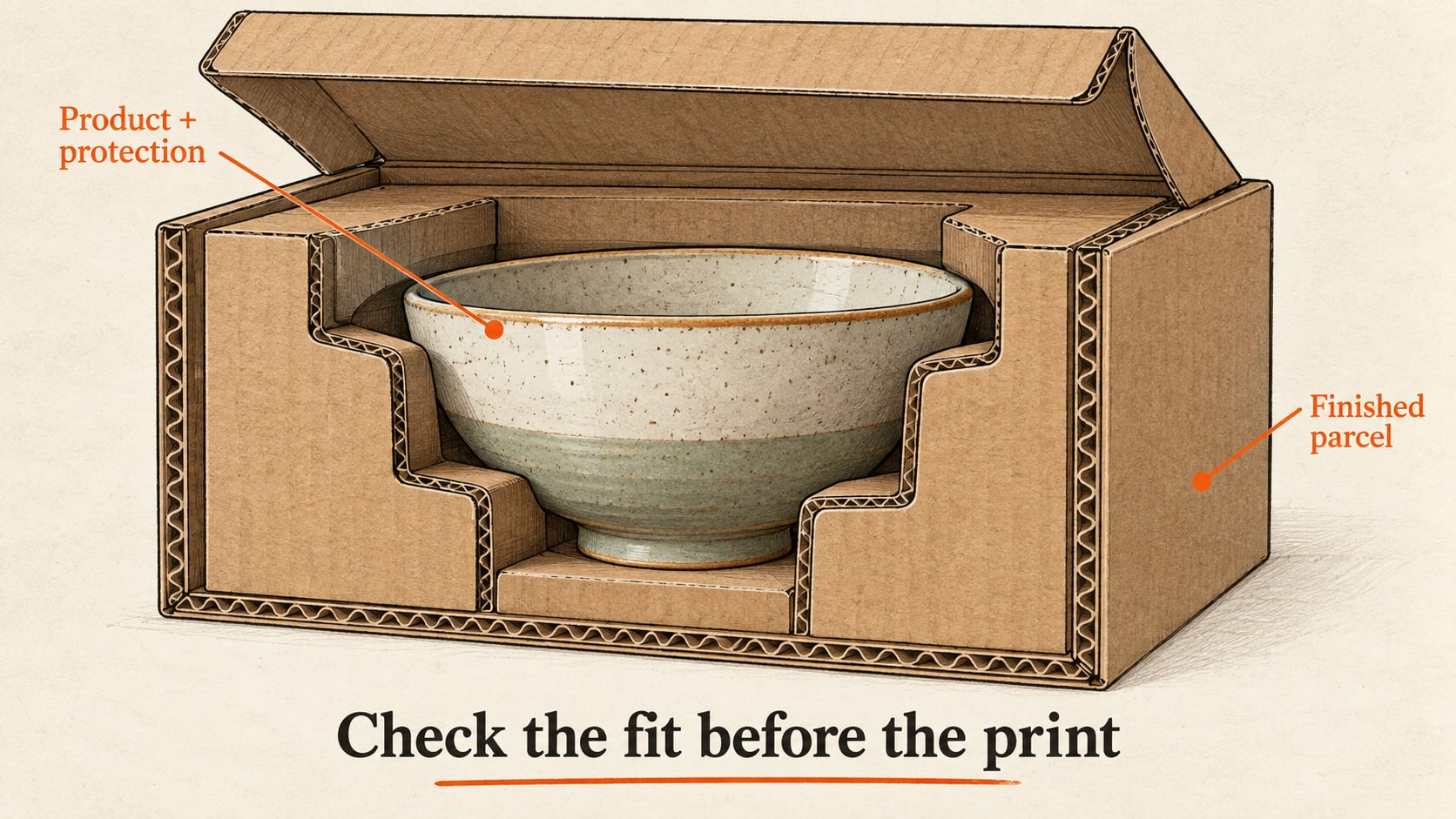
Start with a pack that fits the complete order and gives it appropriate protection. Once that works, decide where the branding belongs. Printing your logo on a box you've never packed is an expensive way to discover the dimensions are wrong.
If the existing pack already does its job, a label or insert is worth comparing with a printed box. The right choice depends on what you need the customer to see, what the packer needs to do and how much packaging you're ready to hold in stock.
Choose the job your packaging needs to do
Be specific about the improvement you want. A care card explains how to use the product. An insert holds it in place. Printing the outer box changes what the customer sees before opening it. Those are different jobs.
| Format | Useful when… | Include in the comparison |
|---|---|---|
| Label on a plain pack | The existing pack works and you want branding on its surface | Label material, adhesion, position and application cost |
| Printed card | You need care instructions, a gift message or brand information inside | Readability, fit and where the packer puts it |
| Printed sleeve | You want a branded band around an existing box | Fit on the assembled box and whether it obscures required information |
| Printed box or mailer | The structure is settled and you want print on the box itself | Material, print, assembly, storage and the outer shipping arrangement |
Get prices for a packed order. Folding a sleeve or adding an insert is part of the work, so it belongs in the quote alongside the printed component.
Measure the complete order
Measure everything that will go inside: the product, accessories, printed material and protection. Then check the actual variants and bundles you plan to ship in that pack.
The inside of a box tells you about usable space. The outside of the closed parcel is what you need for the shipping quote. Keep both measurements, with their units, on the specification.
Packlane, for example, lists its box sizes as inside dimensions and directs buyers to ask for the corresponding outside measurements. Your supplier may use a different convention, so have them identify it explicitly. Packlane's sizing guidance.
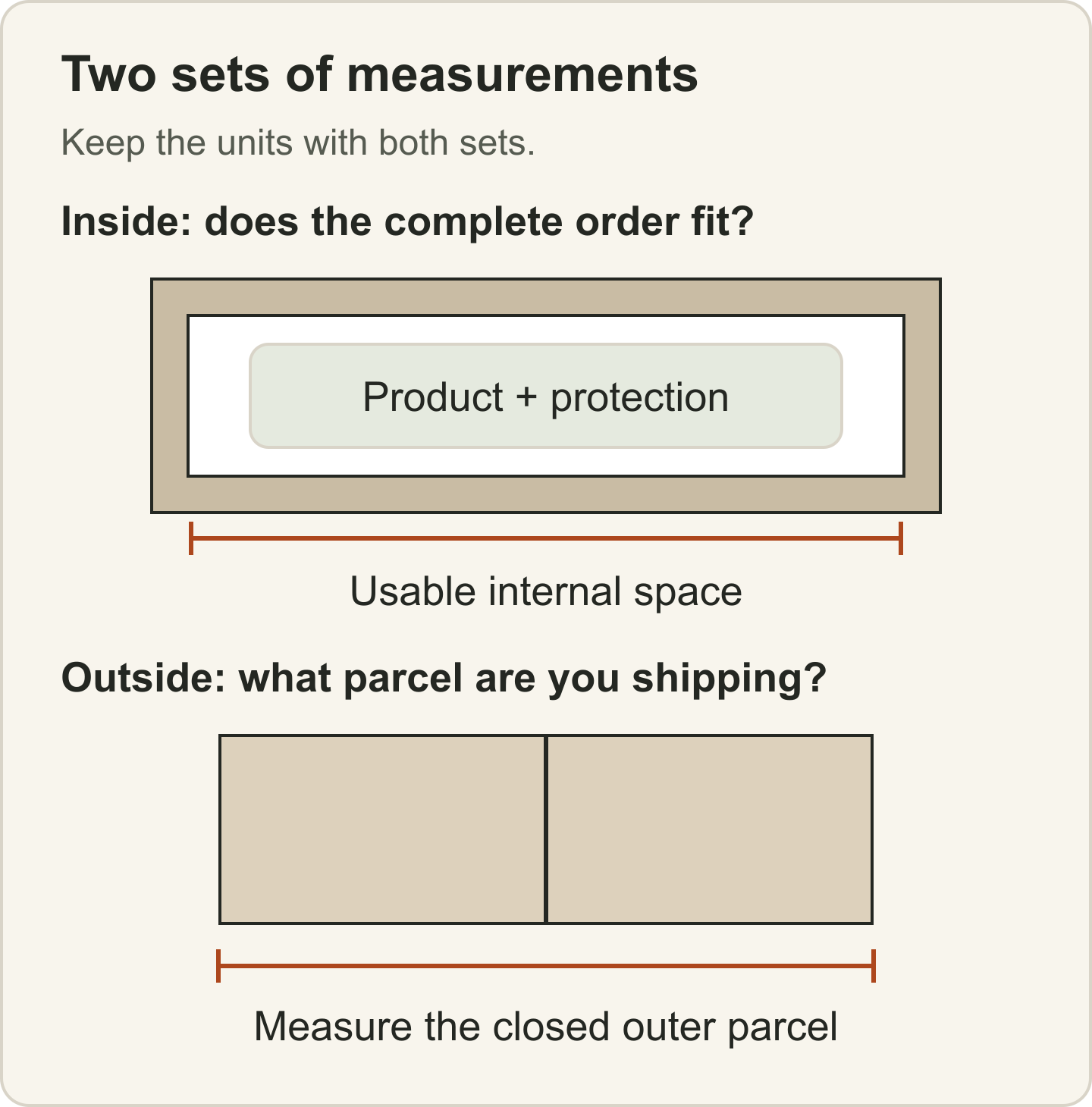
Have the person who will pack the orders assemble a complete sample. Does the box close without forcing it? Are the contents held in place? Can the shipping label sit flat where it needs to go?
Photograph the sequence while the pack is open. A finished-box photo won't show someone where to place an insert or which way round the product goes.
UPS's general guidance calls for suitable cushioning, a rigid box and secure sealing. The packing method still needs to suit your product and service. Agree appropriate transport testing with the supplier or carrier; a tidy sample photo doesn't establish performance in transit. UPS packaging guidance.
Get the right sample before approving print
Ask what the sample will let you check. A material kit can show board and print finishes. It won't tell you whether your complete order fits your chosen dimensions.
Packlane makes this distinction in its own sample options: the kit contains material and print references, while a custom test order is used to check your size or design. Packlane's sample options.
For your packaging, separate the approvals:
- Fit: the complete contents in the proposed structure.
- Print: the artwork on the specified material, in the correct position and orientation.
- Packing: the sequence the person preparing orders will follow.
One sample may answer several of those questions. Record any it leaves unanswered, including differences between the sample and the planned production run.
Check the proof's spelling and artwork version before approving it. Also check what happens at folds, openings and seams. A design can look fine laid out flat and put the important text in an awkward place once assembled.
Know who holds the leftover boxes
The packaging order and the product order don't have to move at the same pace. Write down how much of each packaging component you must buy, who owns it and where it will be stored.
If the supplier keeps it for you, agree how you'll see the remaining stock and what storage or packing charges apply. Decide when they should ask you to reorder.
Set an instruction for shortages too. Should the packer pause orders, use an approved plain alternative or wait for your decision? That is easier to settle now than during a busy dispatch day.
Before ordering a larger print run for a lower unit price, check what happens to unused stock if you change the artwork or move suppliers. The saving needs to justify the quantity you're committing to.
Save the packing method with the approval
Keep this record with the sample photos and artwork files. Complete the approval line only once the outstanding checks have been resolved.
Tick each detail once you have confirmed it. Copy the blank record to save your answers.
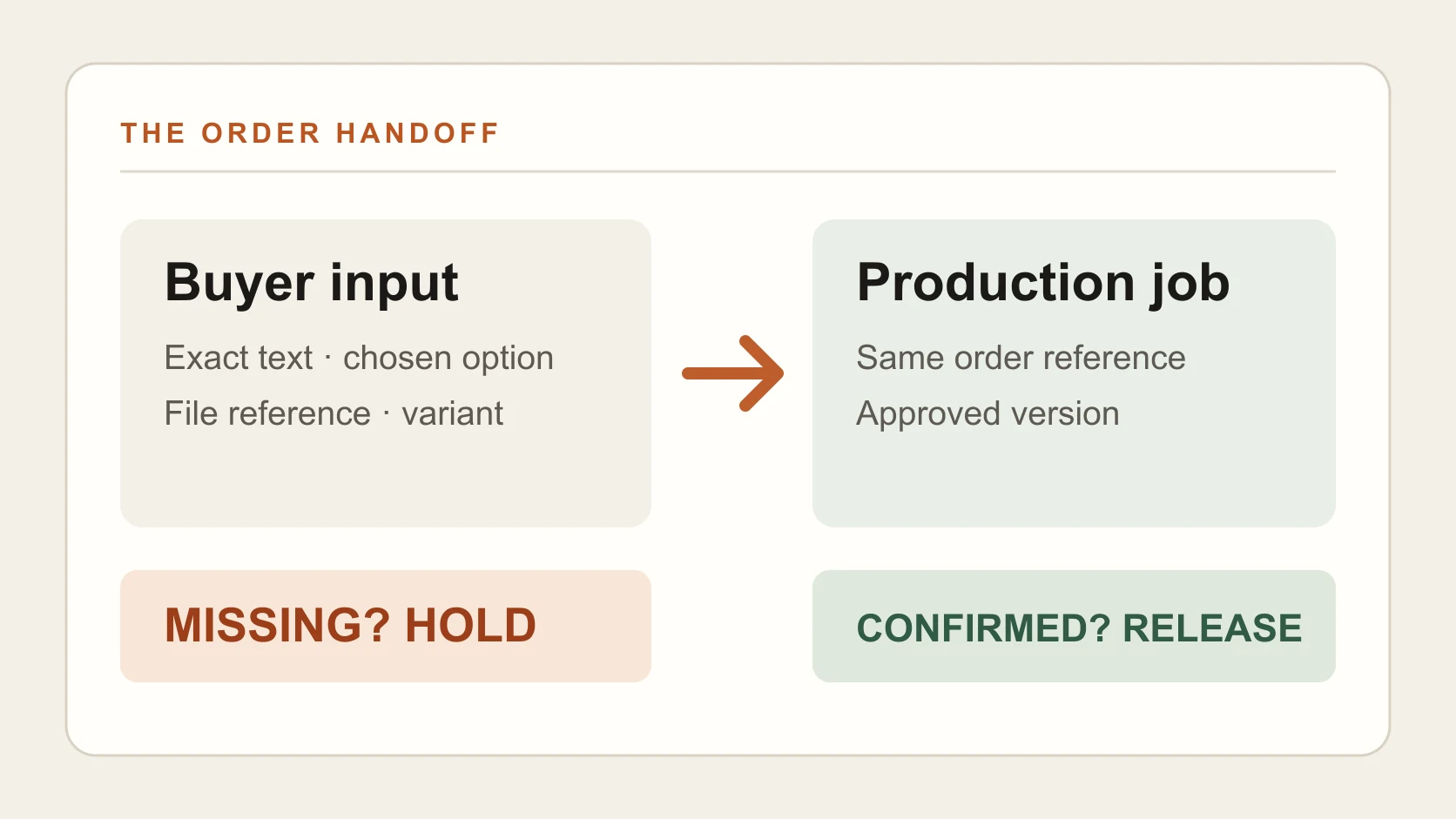
Give the packer the approved version. If the material, size, artwork or packing method changes, update the record before that change reaches a customer's parcel.