Most operators leave 8–15% on the table with their Chinese supplier. Real scripts, real numbers, and the packaging trick that cuts MOQ in half.
The supplier quoted $7.50 per unit on a product the store would sell 50,000 times in year one. The operator said yes. He thought he was being respectful. He thought "no haggling" was the high-trust way to work.
Twelve months later, he ran the math on what he'd actually paid versus what a peer had negotiated on the same SKU from the same factory. The peer was at $6.40. That $1.10 gap, multiplied by 50,000 units, was $55,000 of margin. Gone. Quietly. Because nobody told him the first quote is theater, not a price.
This guide is the operator's playbook for how to negotiate with Chinese suppliers without burning the relationship and without leaving money on the table. You'll get real scripts you can copy, realistic concession benchmarks for each lever, the cultural rules that change which tactics work, and the one structural trick (the packaging unbundle) that almost no one talks about publicly. By the end you'll know how to read the first quote, what to counter with, when to push, when to pause, and what to ask for that goes far beyond unit price.
The first quote isn't a price. It's an opening offer dressed up as one.
The cultural rules that change everything
You can't negotiate with a Chinese supplier the way you'd negotiate with a US contractor. The tactics that win in one culture lose in the other. Three concepts decide whether your counter-offer lands or kills the relationship.
Guanxi: relationships outrun transactions
Guanxi (关系) is the Chinese business concept of relationship capital. A supplier who's done good business with you for two years will give you better terms than a stranger ever gets, even at identical volume. Suppliers reward consistency, respect, and predictability over the toughest negotiator.
What this means in practice: don't optimize a single transaction at the expense of the relationship. The third order matters more than the first. A respectful negotiation that closes at 8% off the first quote often beats an aggressive one that gets 15% off and gets you ghosted on round two.
Mianzi: never make them lose face
Mianzi (面子), usually translated as "face," is closer to social standing in front of peers and superiors. Public criticism, ultimatums, or framing a counter as "your price is too high" makes the rep on the other end lose face. They'll either disengage or pad future quotes to rebuild the margin you took.
The fix: frame every counter as collaborative problem-solving. "We're trying to hit a target landed cost of $5.80. What can we adjust together to get there?" lands better than "Your price is too high." Same goal. Different temperature.
Patience: silence is a tactic, not a stall
Western negotiations move in hours. Chinese supplier negotiations move in days. A two-day gap before a response isn't disinterest. It's the rep checking with the factory owner, calculating margin scenarios, and waiting for you to soften your position.
If you panic and reply with a softer offer before they come back, you've negotiated against yourself. Hold the line. Silence is its own pressure.
The levers beyond price (where the real money lives)
Most negotiations focus 90% on unit price. That's a mistake. Price is one of eight levers, and it's not even the most negotiable one in many cases.
| Lever | Typical concession on first ask | Notes |
|---|---|---|
| Unit price | 5–15% | Capped by factory margin |
| MOQ | 30–50% | Often dictated by packaging, not product |
| Payment terms | 30/70 → 20/80 | Based on relationship trust |
| Incoterms | EXW vs FOB vs DDP | Shifts who pays for shipping/duty |
| Packaging | 5–20% on cost | Strip custom packaging from MOQ math |
| Lead time | 5–7 days | Faster turnaround often available |
| Sample policy | Free/credit on order | Common for serious-looking buyers |
| QC inclusion | $50–$200 saved per order | Often free if asked upfront |
The operators who consistently get the best deals don't negotiate on price alone. They package three or four levers into a single counter-offer, then let the supplier choose which two they're willing to give on.
That's it. That's the entire move. Make a multi-lever ask, name your priority lever, and offer to flex on the others. The supplier feels they're collaborating, not capitulating.
The first quote is theater (and how to read it)
Almost every first quote from a Chinese supplier is padded 8–15% above their walk-away price. This isn't fraud. It's the cultural expectation. Suppliers expect you to negotiate and price the first quote accordingly.
There are three ways to read what a quote actually means:
- Compare against 1688. 1688 is the domestic Chinese version of Alibaba where Chinese buyers source. According to industry analysis from Alibaba's own seller resources, prices on 1688 are typically 10–30% lower than the same product on Alibaba, often from the same factories. Use 1688 listings as your benchmark anchor.
- Ask "what's the price at 5x volume?" The drop from quote-quantity to 5x-quote-quantity tells you how price-elastic the supplier really is. A small drop signals tight margin. A 20%+ drop signals lots of room to negotiate.
- Ask for a cost breakdown. Material, labor, packaging, margin, shipping. A supplier who refuses or stalls on a breakdown is hiding something. A supplier who provides one is signaling they want a long-term relationship.
Suppliers don't negotiate against you. They negotiate against the version of you that pays full price.
Real scripts for each negotiation stage
Most articles tell you to "be respectful." Useless. Here's what to actually send.
Stage 1: Initial inquiry (the right way)
Open with specifics. A supplier who reads "Can you send me your prices" knows you're a tire-kicker. A supplier who reads the message below knows you're a real buyer.
Hi [Name],
I'm [Your Name], owner of [Brand], a [niche] store in the US/UK doing
~[volume] orders/month. I'm looking for a long-term supplier for [product
category], with custom branding from order one and DDP shipping to [markets].
Could you send:
1. Unit cost at 100, 500, and 1,000 units per SKU
2. MOQ with and without custom packaging
3. Lead time on first order
4. Payment terms you typically work with
5. Sample policy
Looking forward to working together.
Thanks,
[Your Name]
Why this works: it signals scale, intent, and seriousness. It also asks for tiered pricing upfront, which forces the supplier to show their volume curve from the start.
Stage 2: Receiving the first quote
Don't accept. Don't reject. Acknowledge and ask the diagnostic question.
Thanks for the detailed quote, [Name]. I appreciate the breakdown.
Two questions before we move forward:
1. What's the MOQ without the custom retail box? (Curious about the
structural floor.)
2. At 2,000 units per order, what does the unit cost look like?
Also, we're targeting a landed cost of around $[target] for this product
in our market. What levers do you think we can adjust together to get
closer to that?
Thanks,
[Your Name]
This script does three things at once: it surfaces the packaging-as-MOQ-driver question, it tests volume sensitivity, and it frames the price gap as a collaborative problem ("levers we can adjust together"). All without saying the supplier's price is too high.
Stage 3: The trade-off counter
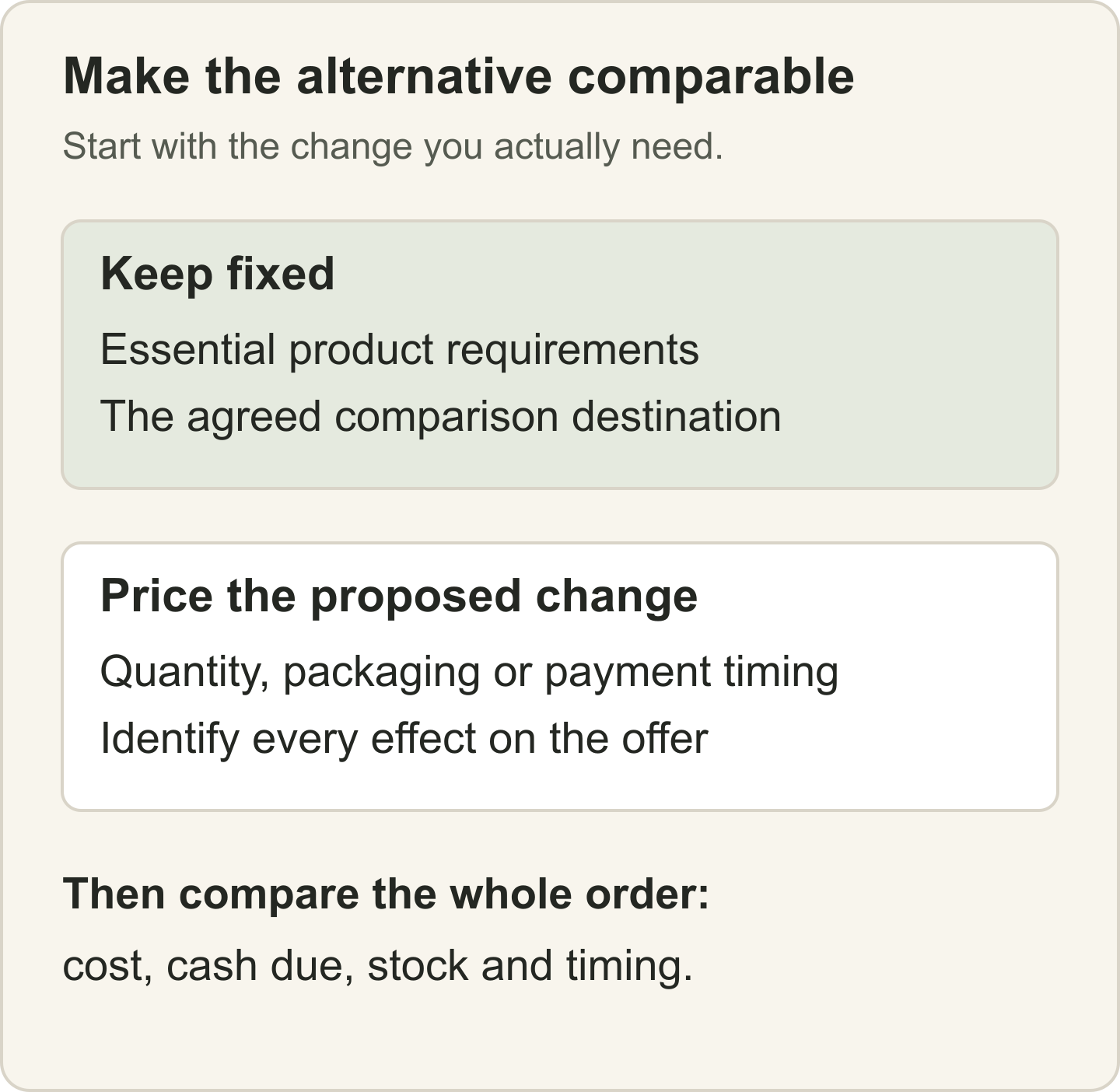
Now you make a multi-lever offer. Pick three levers and propose a package.
Hi [Name],
Thanks for the updated numbers. Here's what I'm thinking:
- 1,500 units on the first order (above your 1,000 MOQ)
- Unit cost: $[your target, ~5-10% below their second quote]
- Payment terms: 30/70 (deposit/balance on shipment)
- Standard mailer packaging on the first order, custom box from order 2
If we can land here, I can commit to a forecast of [realistic 3-month
volume] across the next quarter. Does this work for you?
Thanks,
[Your Name]
Why this works: the supplier got more volume than their MOQ (a win), reasonable payment terms, and a forecast they can show their factory owner. You got the price you wanted, packaging flexibility on order one, and a real commitment runway. Both sides have a story to tell internally.
Stage 4: Closing terms
Once the deal is verbal, lock it in writing. Use this exact phrasing:
Hi [Name],
Great. To confirm, here's what we're agreeing to for the first PO:
- Product: [SKU and spec]
- Quantity: [units]
- Unit cost: $[amount]
- Total: $[amount]
- Payment: 30% deposit on PO, 70% on bill of lading
- Incoterms: [FOB Shenzhen / DDP US / etc.]
- Lead time: [X days from deposit]
- Shipping: [carrier and method]
- Quality standard: [reference photo + spec]
I'll send the deposit on receipt of your pro forma invoice. Looking
forward to a long working relationship.
Thanks,
[Your Name]
Written confirmation prevents the soft re-trade Chinese suppliers sometimes do after a verbal agreement ("our factory is asking for $0.20 more"). The written commitment, in their words, settles it.
How to negotiate MOQ down 50% (the packaging trick)
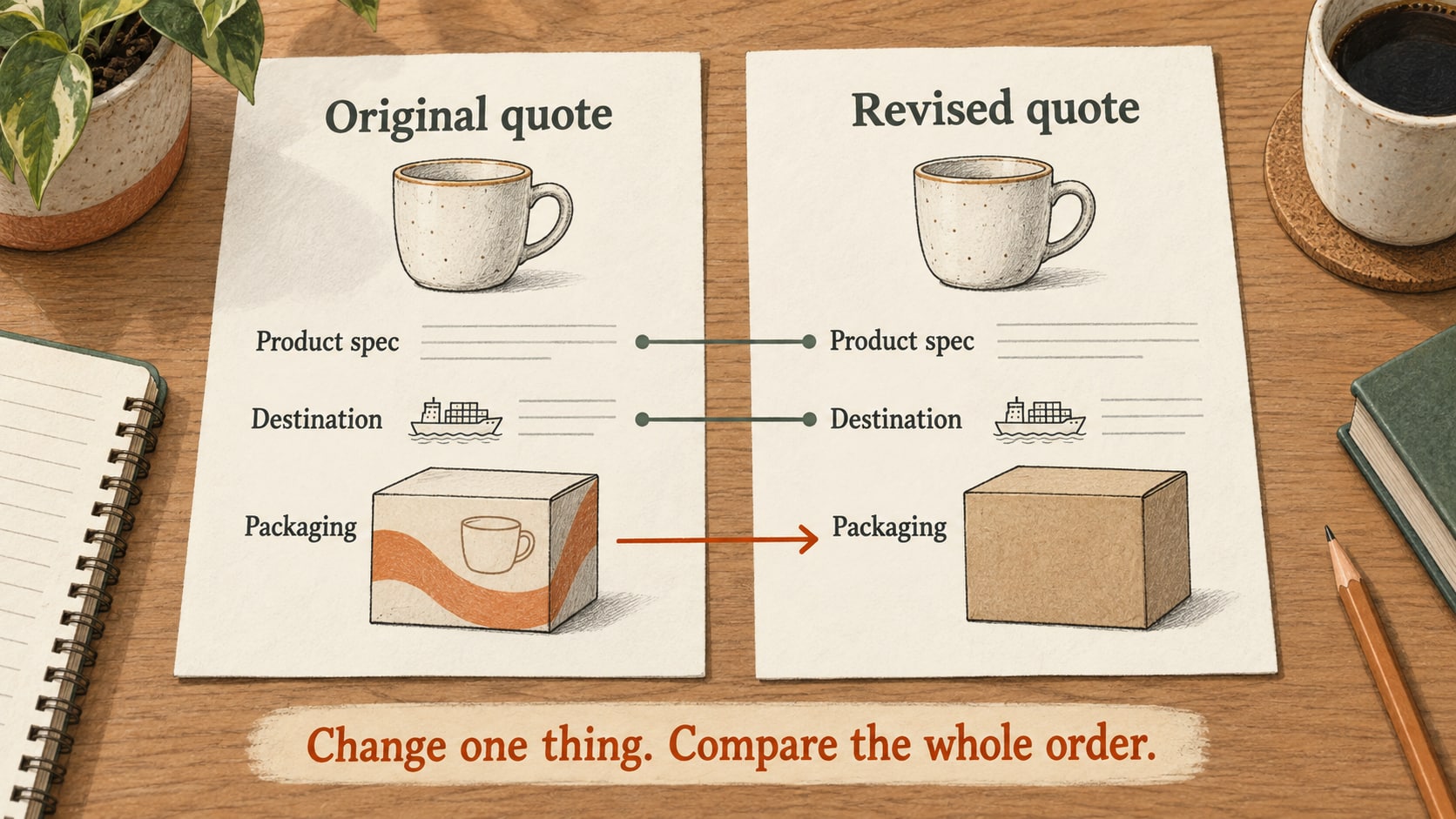
This is the single most underused lever in the entire negotiation, and it lives in one question: "What's the MOQ without custom packaging?"
In most cases, the MOQ a supplier quotes you isn't the floor of how few units the factory can produce. It's the floor at which their custom packaging vendor will print a small run. Strip the custom box from the equation, and the real product MOQ is often 30–50% lower.
When Sarah, an operator selling phone accessories from her home office in Denver, hit her first sourcing wall on Alibaba in March 2025, the quoted MOQ was 1,000 units at $4.20 each. That's $4,200 of inventory she didn't have. She almost walked away. Then she asked: "What's the MOQ without your custom retail box?"
The new quote came back at 300 units, $3.80 each, in plain mailers. Total commitment: $1,140. She placed the order, validated demand, sold through in five weeks, and reordered 1,000 units with custom packaging on round two. The packaging unbundle saved her business.
There are three more sub-tactics for cutting MOQ:
- Offer a per-unit premium for lower MOQ. Telling a supplier "I'll pay 12% more per unit if you can do 400 units instead of 1,000" works because they keep their per-batch margin even at lower volume.
- Forecast future volume. Suppliers move on MOQ when they believe a relationship is coming, not just a transaction. Forecast forward six months in writing.
- Combine SKUs on a single production run. If you sell three SKUs that share materials or packaging, ask if they can run all three on one production cycle to hit minimums collectively.
Payment terms and the second quote nobody asks about
Standard Alibaba payment terms are 30% deposit, 70% on bill of lading. Most operators accept this without realizing it's negotiable.
After two or three successful orders, ask for 20/80. After six months of clean payment history, ask for 10/90. Some long-term operators eventually negotiate to net-30 or net-60 with their suppliers, but only after a year of consistent volume and zero late payments.
The reason this matters: every dollar of deposit you keep in your account is a dollar that funds ad spend or inventory on a different SKU. Improving from 30/70 to 10/90 on a $20,000 PO frees up $4,000 of working capital per cycle.
The second quote (where the bigger wins live)
Almost no negotiation guide talks about this. After 6 months of clean orders, you're entitled to ask for the second quote. This isn't a price war. It's a re-pricing based on the relationship that now exists.
The exact message looks like this:
Hi [Name],
We've been working together six months now and I appreciate how reliable
the orders have been. Quick question: as we plan the next quarter's
production, can we look at a "loyalty rate" for SKUs we've been running
consistently? Happy to forecast the next 90 days as part of the
conversation.
Thanks,
[Your Name]
Most suppliers will offer 5–12% off the second quote without any volume change. They want to lock in a known buyer. You haven't asked aggressively. You've asked the way long-term partners ask.
Currency timing
A small lever, but worth knowing. If the USD has strengthened 2–3% against the CNY since your last order, mention it lightly: "Currency has moved a bit since our last PO. Has that changed anything on your end?" This is a face-preserving way to ask for the FX move to be reflected in the quote.
Common mistakes that kill round 2
Even with good scripts, these mistakes will burn the relationship and shut the door on the second quote that matters more than the first.
- Nickel-and-diming. Pushing for an extra $0.05 per unit on a finalized PO will save you $50 and cost you the relationship. Don't do it.
- The offensively low first offer. Coming in at 50% off the quote signals you don't understand the cost structure. The rep stops responding.
- Going dark mid-negotiation. A two-week silence after asking for a counter signals to the supplier that you're shopping around. They lose interest in giving their best terms.
- Western ultimatum tactics. "I need 30% off or I walk" works in some Western negotiations. In Chinese supplier negotiations, the rep almost always lets you walk. Mianzi makes ultimatums unworkable.
- Negotiating with the wrong person. The sales rep on Alibaba often can't approve big concessions. Politely ask if there's a manager or factory owner who handles strategic accounts. The answer is usually yes.
When to skip the negotiation entirely
Running this entire process well takes 10–15 hours of focused work per supplier. That includes the initial outreach to multiple factories, the back-and-forth, the sample evaluation, the contract finalization, and the ongoing relationship management.
For an operator running a $30K/month store, that time has a real cost. If your hourly value is $80 (modest for someone running a profitable store), you're spending $1,000–$1,500 of your time to save maybe $3,000–$5,000 on the first PO. The math works the first time. It compounds against you when you're sourcing five SKUs across three suppliers.
This is where a private supplier setup changes the equation. Instead of running the negotiation playbook yourself, you work with a team that already has the relationships, the volume leverage, and the cultural fluency to negotiate on your behalf.
That's literally the SupplierMafia model. One chat. Every factory handled. You stay focused on marketing and the storefront, the negotiation work happens in the background, and you get rates that come from aggregated buying power across many stores rather than from your single account's leverage.
Two paths. Pick the one that matches your time and your tolerance for the work.
Your next negotiation, this week
If you've read this far and you have an active supplier relationship, here's what to do in the next seven days:
- Pull your last invoice. Note the unit cost, MOQ, payment terms, and incoterms.
- Send the second-quote message from the section above. Word for word.
- Wait 48 hours for a response. Don't follow up early.
- When the counter comes, package three levers (unit cost + payment terms + lead time) into a single trade-off counter using the Stage 3 script.
- Close in writing using the Stage 4 script.
If you're sourcing fresh, do the same sequence from Stage 1. Send the inquiry to at least five factories. Run the diagnostic on every first quote. The 1688 mirror, the packaging unbundle, the trade-off counter, the second quote — these aren't tricks. They're the structural realities of how Chinese supplier negotiations work in 2026.
The operators winning in this market aren't the most aggressive negotiators. They're the most strategic ones. They know the first quote is theater. They know mianzi is the operating system. They know the second quote matters more than the first. And they know when to run this process themselves versus when to hand it to someone whose entire job is doing it well.
Run the playbook. Save the relationship. Save the margin.
Or skip the playbook entirely and let us handle it. Either way, stop accepting the first quote.